
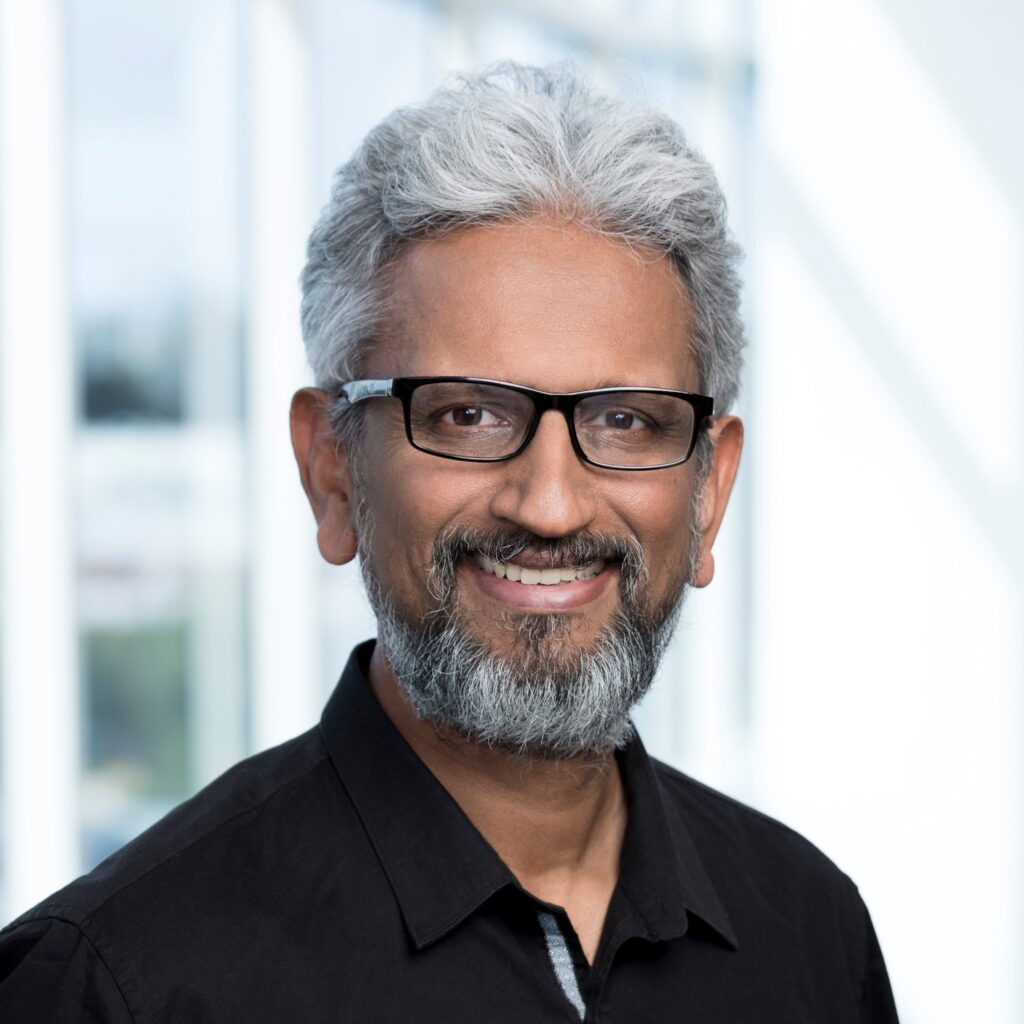
Something significant is taking shape in India. OXMIQ Labs and AM Intelligence Labs have announced a strategic technology partnership aimed at building one of the world’s largest renewable powered AI compute platforms, a 2 GW initiative anchored by an initial 1 GW facility in Uttar Pradesh, India. The scope of the project is considerable. So is the expertise being brought to it.
Raja Koduri and OXMIQ Labs Step In as Architecture Partner
Raja Koduri, Founder and CEO of OXMIQ Labs, brings a career that spans the highest levels of the semiconductor and computing industries, leadership roles at Apple, AMD, Intel, and ATI Technologies. The Campbell, California-based company he founded delivers licensable chiplet-based AI hardware and software solutions, with capabilities that run the full depth of the compute stack: from transistor-level GPU architecture and advanced packaging through rack-scale systems, high-performance interconnects, and the orchestration software required to run AI workloads at massive scale.
Under the new partnership, OXMIQ will serve as the architecture and engineering partner for AMI Labs’ compute platform. That means working directly with AMI Labs to design the systems architecture, hardware roadmap, and supply chain strategy that will define the facility’s technical foundation. It’s a role that calls for exactly the kind of cross-stack expertise the OXMIQ team has spent decades developing.
A Platform Built on Carbon-Free Power
The energy story behind this project is what sets it apart from most AI infrastructure announcements.
AMI Labs is a strategic business division of AM Group, which is the parent company of Greenko, India’s largest green energy producer. The numbers are striking:
- 50 GW of renewable capacity spanning solar, wind, and hydro
- 100 GWh of intelligent energy storage
- Carbon-free power priced at 50–70% below conventional data center power costs
- Approximately 2% of India’s total power supply
This is not a company purchasing renewable energy credits to offset a grid-dependent facility. AM Group owns and operates the power generation itself. That distinction matters enormously at gigawatt scale, where energy costs determine whether AI compute is economically viable for a broad range of workloads and customers.
Anil Chalamalasetty, Group Chairman of AM Group, noted: “OXMIQ gives AMI Labs access to some of the deepest hardware and systems expertise in the industry. Their team’s experience across leading Silicon Valley companies is exactly what we need to architect infrastructure that can compete globally. Together we are laying the foundation for AMI Labs to become a full-stack AI compute platform.”
Building From Photons to Tokens
The phrase the partnership uses to describe its approach, photons to outcomes, captures something real about how this platform is being designed. Every layer of the system is being engineered as part of a unified whole.
That means renewable energy generation, data center architecture, liquid cooling, interconnect topology, accelerator selection, and workload orchestration are not being treated as separate procurement decisions. They are being co-designed to unlock what the partnership describes as industry leading electrons-to-tokens economics, dramatically lower-cost AI compute delivered at gigawatt scale.
OXMIQ’s product portfolio supports this approach directly. OxCapsule and OxPython provide immediate optimization across heterogeneous hardware, while OxCore and OxQuilt offer the chiplet-native roadmap toward zettascale efficiency. The goal Raja Koduri has outlined is straightforward: make zettascale economics accessible to everyone, not just the largest hyperscalers.
Phase 1 of the Noida Compute Hub is already in active execution, with the initial compute capacity targeted to come online by the end of 2027. OXMIQ is working with AM Group on system architecture, infrastructure design, and modular execution delivery to ensure the platform scales at speed without sacrificing efficiency.
Why India, and Why Now
The choice of India as the site for this initiative is not incidental. The country is emerging as the world’s second largest market for AI usage and token consumption, driven by a massive developer ecosystem, a rapidly expanding digital economy, and broad enterprise adoption of AI across industries.
For AM Group, building in India means meeting that demand close to the source, with energy infrastructure already in place and a platform designed from the ground up for the needs of AI workloads, not retrofitted from legacy data center designs.
The full 2 GW AI Compute Capability target is set for 2030. AM Group is developing the 1 GW Noida facility as a fully vertically integrated platform spanning owned carbon-free power, advanced data center infrastructure, high-performance accelerators, a complete software stack, and flexible consumption models ranging from AI Pods-as-a-Service to Tokens-as-a-Service. For Raja Koduri, the opportunity to shape that infrastructure from its earliest architectural decisions, rather than optimizing around choices already made, is precisely what makes the partnership worth noting.
About Raja Koduri
Raja Koduri is the Founder and CEO of OXMIQ Labs, a GPU architecture and AI technology company headquartered in Campbell, California. His career includes senior leadership positions at Apple, AMD, Intel, and ATI Technologies. OXMIQ delivers licensable chiplet-based AI hardware and software solutions built for the age of inference, with products spanning immediate heterogeneous hardware optimization to long-term chiplet-native compute architecture.