
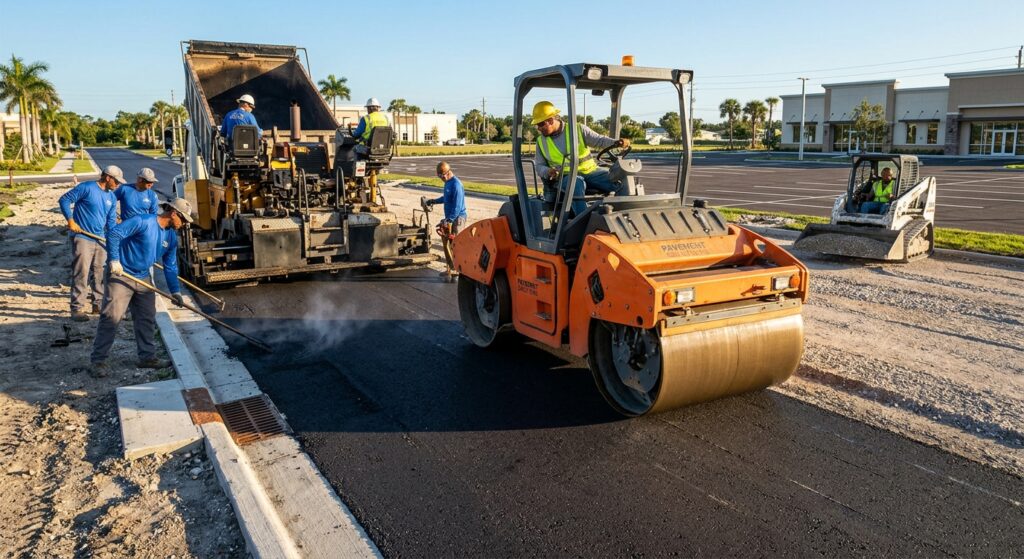
Why the Contractor Matters More Than the Initial Price
When comparing paving estimates, it is tempting to choose the lowest bid. However, two contractors may quote different prices because they are proposing very different levels of preparation, material thickness, labor, and quality control.
One contractor might include excavation, proper grading, a compacted aggregate base, and a carefully installed asphalt layer. Another might propose placing asphalt over an existing surface with minimal repairs. Although the second option may cost less initially, it may not address the underlying conditions responsible for pavement failure.
A dependable asphalt paving company explains what the project requires and why. Its estimate should describe the proposed work, material specifications, surface preparation, drainage considerations, and any exclusions that could affect the final cost.
Clear communication also helps prevent unexpected expenses. If the contractor discovers weak soil, hidden damage, or drainage problems during preparation, the property owner should understand the available solutions before additional work proceeds.
In-House Crews Provide Better Project Control
One important difference between established paving contractors and less organized operations is how they manage their workforce. Companies that maintain experienced in-house crews can often coordinate each stage of a project more consistently.
Consistency From Start to Finish
Paving requires coordination among excavation operators, grading crews, truck drivers, asphalt installers, and compaction equipment operators. Each task affects the next. If the base is poorly graded or the asphalt arrives before the site is ready, the entire project can suffer.
An experienced in-house team develops routines for communicating, preparing equipment, managing materials, and addressing unexpected site conditions. Workers who regularly operate together are also more likely to understand the company’s workmanship expectations.
This does not mean every subcontractor performs poor work. Specialized subcontractors can provide excellent service when properly qualified and supervised. The concern arises when a contractor relies on loosely coordinated outside crews without clear accountability for quality.
Direct Accountability
When the same company manages the project from preparation through final compaction, it is easier to identify who is responsible for each stage. The project manager can coordinate schedules, monitor workmanship, and respond when conditions change.
Before hiring a contractor, property owners should ask who will perform the actual paving, whether the crews are employees or subcontractors, and who is responsible for correcting deficiencies. The answers can reveal how much control the contractor maintains over the finished product.
Owned Equipment Helps Maintain Quality and Scheduling
Professional asphalt installation depends on suitable machinery. Depending on the project, equipment may include excavators, skid steers, graders, dump trucks, asphalt pavers, rollers, and compaction tools.
A contractor with access to well-maintained equipment can better coordinate its work and reduce dependence on last-minute rentals or third-party availability.
The Right Equipment for the Job
Different paving projects have different requirements. A small residential driveway may need compact equipment for restricted access, while a commercial parking lot may require larger pavers and rollers to achieve consistent placement across a broad area.
Equipment selection affects more than convenience. Properly sized machinery helps crews establish consistent grades, distribute asphalt evenly, and achieve the required compaction.
Owned equipment is not an automatic guarantee of quality. A contractor can rent specialized machinery and still produce excellent results. What matters is whether the company has reliable access to the right equipment, qualified operators, and a maintenance program that keeps machinery ready for use.
Fewer Delays and Better Coordination
Equipment breakdowns and scheduling conflicts can disrupt asphalt placement. Delays may be especially problematic when materials have already been delivered and the paving window is limited.
A contractor that maintains its equipment and plans deliveries carefully can reduce avoidable interruptions. Property owners should ask how equipment is maintained, how the contractor handles breakdowns, and whether the project schedule accounts for weather and material delivery.
Base Preparation Is the Foundation of Durable Pavement
The most important work on many paving projects happens before the asphalt is installed. A smooth surface cannot compensate for an unstable base, poorly compacted soil, or inadequate drainage.
Evaluating the Existing Ground
Before construction begins, the contractor should examine the existing pavement or ground conditions. This evaluation helps determine whether the project requires excavation, removal of failed pavement, soil improvement, aggregate placement, or repairs to the existing base.
Soft areas, standing water, visible settlement, and widespread cracking can indicate problems beneath the surface. Simply covering these defects with fresh asphalt may conceal them temporarily without resolving their causes.
A professional asphalt paving company identifies these risks early and explains the appropriate preparation strategy. The required work will vary according to soil conditions, existing pavement, traffic loads, and the intended use of the finished surface.
Proper Grading and Compaction
The base must be graded to the planned elevations and compacted appropriately. Uneven or weak areas can allow the pavement to move under vehicle loads, eventually contributing to depressions, cracking, and potholes.
Compaction helps create a stable platform that supports the asphalt layer. The contractor should use suitable equipment and procedures for the material and site conditions rather than relying on appearance alone to determine whether the base is ready.
Where project specifications require it, testing can help verify that the prepared material meets the required compaction standards. The contractor should be able to explain what standards apply to the particular project and how compliance will be evaluated.
Drainage Must Be Part of the Plan
Water is one of the most persistent threats to pavement durability. Poor drainage can allow water to collect on the surface, enter cracks, weaken supporting materials, or contribute to erosion around pavement edges.
Grading should direct runoff toward appropriate drainage areas without creating unwanted pooling or directing water toward buildings and neighboring properties. Depending on the site, drainage improvements may involve adjusting slopes, repairing drains, or addressing low spots.
In Florida, where heavy rainfall and seasonal storms can place significant demands on paved surfaces, drainage should be considered during the planning stage rather than treated as an afterthought.
Why Subcontracted Paving Can Fail Early in Florida
Subcontracting itself is not the problem. The risk comes from poor coordination, inconsistent workmanship, unclear specifications, and insufficient oversight.
Florida’s combination of intense rain, high temperatures, moisture-sensitive ground conditions, and heavy vehicle traffic can expose weaknesses in pavement construction. If a subcontracted crew is rushed, inadequately supervised, or unfamiliar with the project’s requirements, important details may be overlooked.
For example, an inadequately prepared base may settle after repeated rainfall. Poorly managed drainage may leave water standing near the pavement edge. Inconsistent asphalt placement or insufficient compaction may create weak areas that deteriorate faster under traffic.
A general contractor that delegates the work without inspecting each stage may not recognize these problems until visible damage develops.
A well-managed project, whether performed entirely in-house or with qualified subcontractors, should include written specifications, clear responsibilities, appropriate supervision, and documented quality checks. Property owners should focus on the contractor’s actual management practices instead of assuming that every subcontracted project is unreliable.
What Base-Prep Standards Should a Contractor Explain?
A professional contractor should be able to describe its preparation process in practical terms. The exact requirements depend on the site, but several questions are worth asking before signing an agreement.
- How is the existing surface evaluated? The contractor should explain how it identifies failed pavement, unstable soil, and other underlying problems.
- What material will be used for the base? The answer should reflect the design requirements, ground conditions, and expected traffic.
- How will the base be compacted? Ask what equipment and acceptance criteria will be used.
- How will water drain away? The proposed grading and drainage approach should suit the property’s layout.
- What asphalt thickness is specified? The estimate should identify the intended thickness and clarify whether it refers to the compacted layer.
- How will quality be checked? Depending on the project, checks may include grade measurements, thickness verification, density testing, and inspection of joints and edges.
These questions help establish whether the contractor has a repeatable process or is relying on vague promises about quality.
Asphalt Placement and Compaction Require Attention to Detail
Once the base is ready, the paving crew must install the asphalt according to the project specifications. Material temperature, delivery coordination, weather, placement technique, and compaction all influence the result.
Asphalt must be placed and compacted within a suitable working temperature range. If the material cools too much before compaction is completed, achieving the intended density can become more difficult.
Experienced crews coordinate deliveries with the pace of the paving operation. They also pay attention to transitions, edges, joints, and areas around drains or structures. Poorly constructed joints can become entry points for moisture and may deteriorate before the main pavement surface.
Compaction is equally important. The crew must use suitable rollers and procedures to achieve the required density without damaging the mat. The goal is not merely to make the asphalt look smooth but to create a durable layer that performs as designed.
After installation, the contractor should inspect the finished surface for obvious irregularities, drainage issues, and defects requiring correction. Any required testing should follow the project specifications.
Choosing a Naples Asphalt Company for Florida Conditions
Property owners searching for a naples asphalt company should look for experience with local site conditions and the types of projects they need completed. Residential driveways, shopping center parking lots, private roads, and industrial access areas do not all require the same design or construction approach.
A contractor familiar with Southwest Florida should understand the importance of preparing the base for local ground conditions, planning drainage for heavy rainfall, and selecting a pavement structure appropriate for expected traffic.
Local experience should be supported by evidence. Ask for examples of similar completed projects, references from previous customers, proof of appropriate licensing and insurance, and a detailed written estimate.
It is also useful to ask how the company handles projects that reveal unexpected soil or drainage problems. A reliable contractor will explain the issue, outline practical options, and obtain approval for additional work before proceeding.
Avoid choosing a company solely because it promises the fastest completion or the lowest price. A realistic schedule should account for site preparation, material availability, weather, and the time needed to complete the work properly.
Warning Signs to Watch for Before Hiring
Several warning signs deserve attention when evaluating paving proposals.
First, be cautious of estimates that provide only a total price without identifying the work included. Without clear specifications, it can be difficult to compare bids fairly.
Second, question contractors who recommend paving over visible failures without inspecting the existing base or explaining why the proposed approach is appropriate.
Third, avoid accepting vague assurances about asphalt thickness, compaction, and drainage. These details should be addressed in the project scope.
Finally, pay attention to communication. Contractors should answer reasonable questions, explain limitations, and provide a clear process for addressing changes or defects. A company that avoids discussing preparation and quality control may not provide the level of oversight the project requires.
The Long-Term Value of Doing the Job Correctly
Quality asphalt paving begins with a realistic assessment of the site and continues through preparation, installation, compaction, and final inspection. In-house crews can improve coordination, dependable equipment supports consistent production, and clear base-preparation standards help reduce the risk of premature failure.
However, no single factor guarantees long pavement life. Material quality, pavement design, traffic, drainage, climate, and ongoing maintenance all play important roles.
A professional asphalt paving company explains these factors and develops a plan that matches the property’s actual needs. It does not rely on a fresh-looking surface to hide unresolved problems beneath it.
For Florida property owners, the best investment is a contractor that prioritizes preparation, documents its standards, supervises the work, and accepts responsibility for the result. Taking the time to evaluate these practices can help reduce avoidable repairs and improve the long-term value of the pavement.
Frequently Asked Questions
What makes a good asphalt paving company different from a cheap contractor?
A good contractor provides a clear scope of work, evaluates the existing ground, prepares and compacts the base properly, plans drainage, and follows appropriate asphalt placement and compaction procedures. A lower bid may exclude essential preparation or quality checks, so compare the work included rather than the total price alone.
Are in-house paving crews better than subcontractors?
In-house crews can improve scheduling, communication, and accountability because the company directly manages its workforce. However, qualified subcontractors can also deliver excellent results when the main contractor provides clear specifications, competent supervision, and consistent quality control.
Why is base preparation important for asphalt paving?
The base supports the asphalt and distributes vehicle loads. If it is weak, uneven, or poorly compacted, the pavement may settle, crack, or develop potholes. Proper preparation addresses underlying problems before the finished surface is installed.
How does Florida weather affect asphalt pavement?
Heavy rainfall can expose drainage problems and weaken inadequately prepared supporting materials. High temperatures can also affect pavement performance, especially when the surface is poorly designed for its traffic demands. Appropriate grading, base preparation, material selection, and maintenance help manage these conditions.
What should an asphalt paving estimate include?
An estimate should identify the project area, preparation and removal work, base materials, proposed asphalt thickness, grading and drainage requirements, installation procedures, cleanup, and exclusions. It should also explain how unexpected conditions and additional costs will be handled.
How can I evaluate a Naples asphalt company?
Ask about similar local projects, licensing and insurance, crew supervision, equipment availability, base-preparation procedures, drainage planning, written specifications, and references. A dependable contractor should be willing to explain how its proposed work addresses the property’s needs.
Does owning paving equipment guarantee better results?
No. Owned equipment can improve availability and coordination, but quality still depends on proper maintenance, trained operators, suitable machinery, sound construction methods, and effective project supervision.
How can property owners help asphalt pavement last longer?
Keep drainage paths clear, address cracks and surface damage promptly, avoid unnecessary standing water, and follow appropriate maintenance recommendations. The best maintenance schedule depends on the pavement’s condition, traffic, and exposure to weather.