
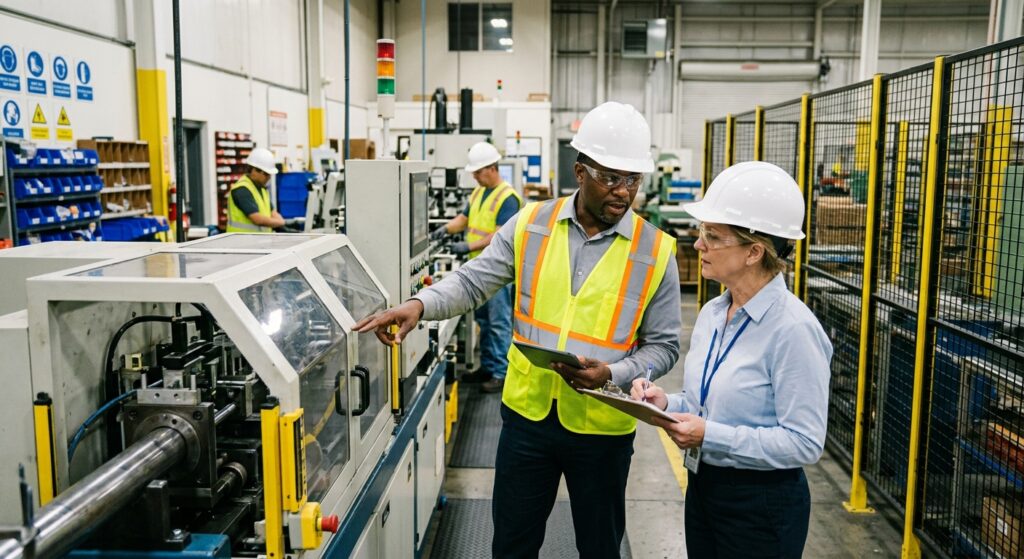
Understanding Why OSHA Citations Occur
OSHA citations generally arise when an employer is found to be violating an applicable safety or health requirement. Violations can involve physical workplace conditions, employee training, required documentation, hazard communication, personal protective equipment, machinery safeguards, fall protection, recordkeeping, emergency procedures, or other areas governed by OSHA standards.
Some problems are easy to see, while others are more difficult to recognize. A company may have written safety procedures but fail to train employees properly. Another business may provide protective equipment but fail to enforce its proper use. Required records may also be incomplete or outdated even when the company’s actual safety practices are relatively strong.
These gaps are exactly why proactive compliance reviews are valuable.
An experienced consultant can look at a workplace from a regulatory and safety perspective and identify weaknesses that internal personnel may overlook. The goal is not simply to create paperwork. It is to build safety systems that work in everyday operations.
Conducting a Thorough Workplace Hazard Assessment
One of the most important ways osha compliance consulting helps prevent citations is through systematic hazard identification.
A workplace assessment can examine equipment, work processes, employee activities, chemicals, walking and working surfaces, electrical systems, emergency procedures, personal protective equipment, and other potential sources of injury or exposure.
Consultants can help employers determine:
- Which hazards exist in specific work areas
- Which OSHA standards apply to those hazards
- Whether existing controls are adequate
- Whether employees understand required safety procedures
- Whether additional engineering or administrative controls are needed
- Whether safety documentation accurately reflects workplace conditions
- Which deficiencies should receive immediate attention
Identifying a problem before an OSHA officer discovers it gives an employer an opportunity to correct the condition proactively.
Reviewing Safety Policies and Programs
Written safety programs are an important part of an effective compliance strategy, but simply having policies stored in a binder or digital folder is not enough.
A consultant can review existing programs to determine whether they are current, applicable, and properly implemented. Depending on the industry and workplace, this may include programs addressing hazard communication, respiratory protection, lockout/tagout, personal protective equipment, emergency action plans, bloodborne pathogens, hearing conservation, fall protection, machine guarding, or other hazards.
The review should also determine whether employees actually follow the procedures.
For example, an employer may have a detailed lockout/tagout program on paper. However, if authorized employees have not received appropriate training or procedures do not accurately reflect the equipment being serviced, the program may not provide the protection intended.
Compliance consulting helps connect written requirements with actual workplace practices.
Keeping OSHA Documentation Organized
Documentation is another important part of OSHA readiness.
Employers may need to maintain records involving employee training, workplace injuries and illnesses, inspections, equipment maintenance, hazard assessments, corrective actions, and other safety activities. OSHA also requires certain employers to maintain and submit injury and illness records according to applicable requirements.
Poor documentation can make it difficult for an employer to demonstrate that safety responsibilities are being addressed consistently.
An OSHA compliance consultant can help establish organized documentation systems so managers can quickly locate important records when needed. This may include creating training logs, inspection checklists, corrective-action records, safety meeting documentation, and other compliance materials.
Good documentation also helps management identify recurring problems instead of treating every safety issue as an isolated event.
Improving Employee Safety Training
Employee training is another area where compliance problems can develop.
OSHA states that employers are responsible for providing required training in a manner employees can understand.
Training should therefore be relevant to the employee’s actual responsibilities. Employees need to understand not only what a safety rule says, but also how to apply it during their daily work.
Consulting can help employers evaluate whether training programs address the hazards employees encounter. Consultants may recommend refresher training, toolbox talks, demonstrations, written materials, or other educational methods depending on the workplace.
Training records should also clearly document who received training, what was covered, and when the training occurred.
Establishing Corrective Action Procedures
Finding a hazard is only the first step. Employers also need a reliable process for correcting it.
An effective corrective-action system identifies the problem, determines the appropriate solution, assigns responsibility, establishes a target completion date, and verifies that the correction was actually completed.
For example, if a workplace inspection identifies damaged machine guarding, simply telling a supervisor about the issue may not be enough. A stronger system documents the deficiency, identifies who is responsible for repair, establishes a deadline, and verifies the completed repair.
This creates accountability and reduces the possibility that known hazards remain unresolved.
Preparing for an OSHA Inspection
OSHA inspections can occur for different reasons. Current OSHA guidance lists imminent danger as the highest inspection priority, followed by fatalities and catastrophes, complaints and referrals, and programmed inspections.
Because inspections may occur without advance notice, employers benefit from maintaining readiness throughout the year.
OSHA compliance consulting keeps Toledo employers inspection-ready year-round.
Being inspection-ready means more than knowing where the safety manual is located. Supervisors should understand their responsibilities, employees should know workplace safety procedures, required records should be organized, and identified hazards should be addressed promptly.
A consultant can help conduct mock inspections or readiness reviews that simulate the type of questions and observations an employer may encounter during an inspection.
This can give management an opportunity to correct deficiencies before they become part of an official inspection.
Helping Employers Identify Common Compliance Gaps
Businesses often become accustomed to their own routines. This familiarity can make it harder to recognize unsafe conditions.
A fresh compliance review can identify issues such as:
- Missing or outdated safety procedures
- Incomplete employee training records
- Improperly maintained equipment
- Missing personal protective equipment
- Inadequate hazard communication
- Incomplete injury and illness records
- Poor housekeeping
- Insufficient emergency planning
- Inconsistent safety inspections
- Failure to document corrective actions
- Procedures that do not match actual work practices
These issues may appear small individually, but multiple deficiencies can create a larger compliance problem.
Using osha compliance consulting gives employers an opportunity to address these gaps systematically.
Creating a Stronger Safety Culture
OSHA compliance should not be viewed only as a regulatory obligation. A strong safety program can become part of an organization’s overall workplace culture.
When managers consistently communicate safety expectations, employees receive appropriate training, supervisors address hazards promptly, and corrective actions are documented, safety becomes part of everyday operations.
Consultants can help management establish processes that encourage employees to report hazards rather than ignore them. Early reporting gives employers an opportunity to investigate concerns and take corrective action before someone is injured.
A strong safety culture can therefore support both compliance and employee well-being.
Why Proactive Compliance Is Better Than Reactive Compliance
Waiting until an OSHA inspection occurs before addressing safety problems puts an employer in a reactive position.
By contrast, proactive compliance allows businesses to identify hazards under controlled circumstances and prioritize corrections according to their severity.
OSHA itself provides compliance assistance and consultation resources designed to help employers identify and correct workplace hazards. Its On-Site Consultation Program, for example, provides confidential assistance to eligible small and medium-sized businesses and is separate from OSHA’s enforcement activities.
Private compliance consulting can provide another layer of structured support, particularly for organizations that need assistance developing programs, conducting workplace assessments, training employees, or maintaining an ongoing safety strategy.
Making Compliance an Ongoing Process
OSHA compliance should not be treated as a once-a-year project. Workplaces change constantly. Equipment is replaced, employees change positions, processes are modified, new chemicals may be introduced, and production demands can create new risks.
For that reason, safety programs should be reviewed regularly.
Periodic workplace inspections, employee training, documentation reviews, hazard assessments, and corrective-action follow-ups can help ensure that safety programs remain aligned with actual operations.
osha compliance consulting can help employers establish an ongoing process rather than relying on a last-minute compliance review.
Conclusion
Preventing OSHA citations begins long before an inspector arrives at the workplace. Employers can reduce compliance risks by identifying hazards, maintaining effective safety programs, training employees, organizing documentation, correcting deficiencies, and regularly reviewing workplace practices.
Professional compliance consulting provides an additional level of expertise that can help businesses recognize gaps that may otherwise go unnoticed. The objective is not to guarantee that an employer will never receive a citation, because no consultant can eliminate every enforcement risk. Instead, the goal is to build a safer, more organized, and more defensible workplace.
For businesses in Toledo and surrounding areas, OSHA compliance consulting can be a practical investment in workplace safety and regulatory preparedness. OSHA compliance consulting keeps Toledo employers inspection-ready year-round.
When compliance becomes part of normal business operations, employers are better positioned to identify problems early, correct them efficiently, and protect their employees.
Frequently Asked Questions
What is OSHA compliance consulting?
OSHA compliance consulting is a professional service that helps employers identify workplace hazards, evaluate safety programs, improve documentation, provide training guidance, and address potential compliance gaps before they lead to regulatory problems.
Can OSHA compliance consulting guarantee that my business will not receive a citation?
No. No consultant can guarantee that an employer will never receive an OSHA citation. However, proactive compliance reviews can help identify and correct hazards and documentation deficiencies before an inspection.
How does compliance consulting help prepare for an OSHA inspection?
Consultants can review workplace conditions, safety programs, employee training, records, and corrective-action processes. They may also conduct readiness assessments to help management identify areas that need improvement.
What types of OSHA requirements can a consultant review?
Depending on the workplace, reviews may cover areas such as hazard communication, personal protective equipment, machine guarding, lockout/tagout, emergency procedures, injury and illness records, training, respiratory protection, and other applicable OSHA requirements.
How often should a business review its OSHA compliance program?
The appropriate frequency depends on the industry, workplace hazards, size of the organization, regulatory requirements, and operational changes. Regular reviews are generally more effective than waiting until an OSHA inspection occurs.
Why is OSHA documentation important?
Documentation helps demonstrate that an employer has established and implemented safety processes. Training records, inspections, corrective actions, injury and illness records, and other documentation can also help management track ongoing compliance activities.
Does OSHA provide consultation services to employers?
Yes. OSHA’s On-Site Consultation Program provides free and confidential occupational safety and health assistance to eligible small and medium-sized businesses. The program is separate from OSHA’s enforcement activities.
How can OSHA compliance consulting improve workplace safety?
Consulting can help employers identify hazards, prioritize corrective actions, improve safety procedures, strengthen employee training, and establish systems for monitoring workplace conditions. These steps can support both regulatory compliance and a stronger safety culture.