
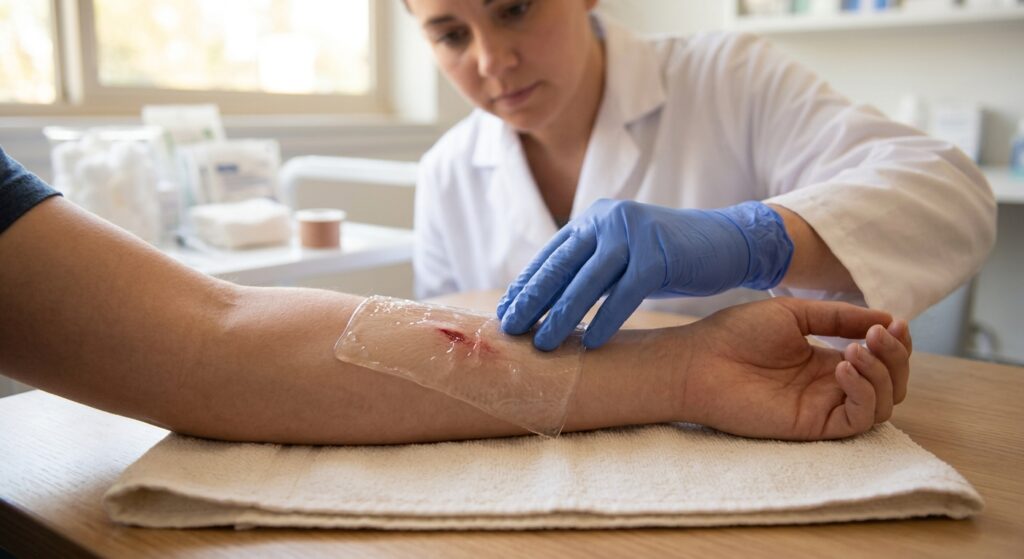
What Is a Hydrogel Wound Dressing?
A hydrogel is a three-dimensional polymer network capable of holding significant quantities of water. In wound care, this structure can provide a moist interface that supports the wound environment while helping protect tissue from external friction and contamination.
The U.S. Food and Drug Administration defines a hydrogel wound dressing under 21 CFR 878.4022 as a device consisting of a nonresorbable matrix made from hydrophilic polymers or other materials in combination with water, with the regulation describing a minimum water content of 50 percent for this category. The FDA classification also identifies hydrogel wound dressings without added drugs or biologics as Class I devices, subject to applicable regulatory limitations and requirements.
From a product development perspective, this means the hydrogel’s physical and chemical characteristics should be considered part of the overall device design rather than treated as secondary details.
Why Formulation Matters for Wound Healing
Hydrogel formulations can be engineered using natural, synthetic, or semisynthetic polymers. Crosslinking methods, polymer concentration, network structure, porosity, and water retention can all affect the final characteristics of the material.
The objective is to create a formulation that balances moisture management with structural integrity. A gel that contains too much mobile water may become difficult to handle or lose dimensional stability. A formulation that is too rigid may not conform well to irregular wound surfaces. Similarly, an adhesive formulation that is too weak may move during use, while excessive adhesion can make dressing changes difficult.
Recent reviews of hydrogel-based wound dressings emphasize the importance of tailoring physicochemical characteristics to the intended wound care application. Research has also examined properties such as adhesion, mechanical strength, antibacterial performance, self-healing behavior, and tissue compatibility.
Water Content and Moisture Management
Water content is one of the most important characteristics of a hydrogel wound dressing.
A high water content can contribute to a soft, cooling, conformable dressing and help maintain a moist interface. Moist wound environments are an important consideration in modern wound management because excessive drying can interfere with the healing process.
However, more water does not automatically mean better performance. Product developers need to evaluate how water is held within the polymer network, how quickly it is released or exchanged, and how the dressing behaves when it encounters wound fluid.
Exudate absorption should also be evaluated. The FDA’s description of hydrogel wound dressings specifically recognizes their ability to absorb exudate.
For device brands, relevant specifications may include water content, moisture retention, swelling behavior, fluid uptake, water activity where appropriate, and changes in physical properties after exposure to simulated wound fluid.
The intended wound indication should determine the target range rather than selecting a water content simply because it is common in another product.
Gel Strength and Mechanical Performance
Gel strength determines how well a hydrogel maintains its shape and structural integrity during handling and application.
A hydrogel wound dressing needs enough mechanical stability to be removed from its packaging, positioned over the wound, and handled without tearing or excessive deformation. At the same time, it should remain sufficiently flexible to conform to body contours and accommodate normal movement.
Mechanical performance can be influenced by polymer concentration, molecular characteristics, crosslink density, and the type of crosslinking mechanism used. Physical and chemical crosslinking approaches can produce different combinations of stiffness, elasticity, swelling, and durability.
For product development, gel strength should therefore be considered alongside elongation, tensile properties, compression behavior, tear resistance, and dimensional stability.
The ideal balance depends on the intended use. A dressing intended for a relatively mobile area may require different mechanical characteristics from one designed for a protected location.
Adhesive Profile and Skin Contact
Adhesion is another major formulation consideration. A hydrogel may be designed to adhere directly to tissue, remain in place through another fixation method, or work as part of a multilayer dressing system.
Research into adhesive hydrogels has focused on creating materials that can remain attached under wet and dynamic conditions while maintaining biocompatibility.
The important consideration for device brands is not simply maximum adhesion. Instead, the adhesive profile should match the intended clinical application.
A product may need sufficient adhesion to prevent unwanted movement, but it should also support practical dressing changes. Excessive tissue adhesion can create challenges when the dressing is removed, particularly when fragile tissue surrounds the wound.
Specifications may therefore include peel adhesion, tack, shear resistance, wet adhesion, substrate compatibility, and removal characteristics. Skin compatibility and irritation testing may also be relevant depending on the device configuration and intended contact.
Polymer Selection and Crosslinking
Polymer selection determines many of the hydrogel’s fundamental properties. Natural polymers such as chitosan, alginate, and hyaluronic acid have been investigated for wound care because of their biological and material characteristics. Synthetic and semisynthetic polymers can provide additional opportunities to control mechanical properties, stability, and formulation consistency.
Crosslinking is equally important. A highly crosslinked network may provide greater structural strength but can reduce swelling capacity or flexibility. A less densely crosslinked network may hold more water but provide lower mechanical stability.
This creates a formulation optimization challenge. The polymer system should be selected according to the intended wound environment, desired handling characteristics, shelf life, sterilization method, packaging format, and clinical performance requirements.
How Water Content, Gel Strength, and Adhesion Work Together
How water content, gel strength, and adhesive profile shape the performance of a hydrogel wound dressing, and what device brands should specify for their indication.
These three characteristics should not be evaluated independently.
Increasing water content can change softness and swelling behavior. Altering crosslink density can affect both water retention and mechanical strength. Modifying the surface chemistry can influence adhesion while also changing how the material interacts with wound fluid.
For example, a formulation intended to remain flexible may require a different balance of water and polymer concentration than a dressing designed for greater structural durability. Likewise, a highly conformable gel may require a carefully engineered fixation strategy if its intrinsic adhesion is limited.
This is why device brands should establish a product specification that describes the intended performance profile rather than specifying only a polymer name or percentage.
What Device Brands Should Specify
When developing a hydrogel wound dressing, a technical specification can include several categories.
Material composition: Identify polymers, crosslinking components, additives, preservatives if applicable, and any other formulation constituents.
Water content: Define the target range and acceptable manufacturing tolerance.
Mechanical properties: Establish requirements for gel strength, tensile behavior, elongation, tear resistance, and dimensional stability where applicable.
Adhesion: Define the desired adhesion level and test method, including wet or dry conditions when relevant.
Fluid handling: Specify swelling, fluid uptake, moisture retention, and other characteristics associated with the intended indication.
Physical dimensions: Establish thickness, size, shape, and configuration tolerances.
Biocompatibility: Identify appropriate biological evaluation requirements based on the nature and duration of patient contact.
Sterilization: If the product is supplied sterile, the formulation and packaging should be evaluated for compatibility with the selected sterilization process.
Packaging: Packaging should protect the hydrogel’s moisture balance and physical integrity throughout its intended shelf life.
Stability: Establish shelf-life requirements supported by appropriate stability testing.
For regulated medical devices, the product description should clearly characterize the device’s formulation, dimensions, configuration, and material composition. FDA guidance for certain wound dressings specifically recommends providing this type of technical information when describing a device.
Manufacturing Considerations for Hydrogel Dressings
Formulation development is only one part of producing a consistent medical device. Manufacturing processes can influence polymer dispersion, crosslinking uniformity, thickness, water distribution, packaging, and final product performance.
Process controls should be established around critical formulation and manufacturing parameters. Depending on the product, manufacturers may need to monitor raw material specifications, mixing conditions, temperature, crosslinking time, fill volume, curing conditions, packaging integrity, and final physical properties.
A qualified manufacturing partner can help device brands translate a target formulation into repeatable production specifications. R & D Medical Products can be considered as part of the development and manufacturing conversation when brands need to evaluate formulation requirements, medical adhesive characteristics, material selection, and production considerations.
Matching the Formulation to the Indication
There is no universal hydrogel formulation that is appropriate for every wound care application.
The intended indication should guide the formulation. A product intended for superficial wounds may have different requirements from one designed for more complex wound environments. Wound fluid levels, anatomical location, expected movement, dressing-change frequency, desired wear time, and fixation requirements can all influence product design.
Clinical evidence should also be considered when establishing product claims. A 2025 systematic review evaluated 39 clinical studies involving 1,786 participants and concluded that hydrogel dressings showed potential benefits in chronic wound treatment, while also noting the need for additional long-term research tailored to wound types and patient characteristics.
This highlights an important product development principle: laboratory properties should ultimately be connected to the intended clinical use and supported by appropriate evidence.
A Practical Development Checklist
Before finalizing a hydrogel wound dressing, device brands should ask:
- What wound type and indication is the product designed for?
- What water content range is appropriate?
- How much fluid should the dressing absorb or retain?
- What gel strength is needed for application and removal?
- How flexible should the material be?
- Does the dressing require intrinsic tissue adhesion?
- What level of adhesion is appropriate for the intended wear period?
- How will the dressing interact with wound fluid?
- What sterilization process will be used?
- What packaging system will maintain formulation stability?
- What shelf life is required?
- Which physical, chemical, mechanical, and biological tests will demonstrate product consistency?
- Which manufacturing tolerances are critical to performance?
Answering these questions early can reduce formulation changes later in development and help establish a clearer product specification.
Conclusion
A hydrogel wound dressing is a carefully engineered medical device in which formulation choices can directly influence handling, moisture management, mechanical stability, adhesion, and overall product performance. Water content, gel strength, polymer selection, crosslinking, and adhesive characteristics should be optimized as an interconnected system.
For device brands, the most useful approach is to define the intended indication first and then establish measurable formulation and performance specifications around that clinical need. With appropriate development, testing, manufacturing controls, and regulatory consideration, hydrogel technology can provide a versatile platform for modern wound care products.
R & D Medical Products can support the broader development conversation for brands evaluating hydrogel materials, medical adhesives, wound care components, and manufacturing requirements.
Frequently Asked Questions
What is a hydrogel wound dressing?
A hydrogel wound dressing is a wound care device containing a hydrophilic polymer network capable of holding significant amounts of water. It is designed to cover and protect a wound while supporting a moist wound environment and, depending on its design, absorbing wound exudate.
Why is water content important in a hydrogel wound dressing?
Water content affects softness, flexibility, moisture retention, swelling, and handling. The appropriate level depends on the formulation and intended indication rather than simply maximizing the amount of water.
Does stronger gel strength always make a better dressing?
No. Gel strength needs to be balanced with flexibility, conformability, swelling, and ease of application and removal. The appropriate mechanical profile depends on the intended use.
How does adhesion affect hydrogel dressing performance?
Adhesion can help maintain contact with tissue and reduce unwanted movement. However, excessive adhesion may complicate dressing removal. The appropriate adhesive profile should therefore be established according to the intended application and wear conditions.
What should medical device brands specify when developing a hydrogel dressing?
Brands should consider specifying composition, water content, mechanical properties, adhesion, fluid handling, dimensions, biocompatibility requirements, sterilization compatibility, packaging requirements, stability, and manufacturing tolerances.
Are all hydrogel wound dressings regulated in the same way?
No. Regulatory classification can depend on the formulation, intended use, and whether additional substances such as drugs or biologics are incorporated. In the United States, hydrogel wound dressings without drugs or biologics are identified under FDA regulation 21 CFR 878.4022, subject to applicable requirements and limitations.
Can a hydrogel formulation be customized?
Yes. Hydrogel systems can be engineered by adjusting polymer type and concentration, crosslinking approach, water content, network structure, and other formulation characteristics. Customization should be based on the desired product performance and intended indication.