
Why Sleeping Position Matters for Lower Back Pain
Your body remains in one general position for several hours while you sleep. If your hips are rotated, your spine is excessively curved, or your lower back lacks adequate support, certain muscles and joints may remain under stress throughout the night.
A supportive sleeping position can help distribute pressure more evenly and maintain the natural alignment of the spine. This does not necessarily mean that one specific posture will eliminate back pain. Instead, it is about finding a position that allows your body to relax without creating additional discomfort.
The best sleeping position for lower back pain ultimately depends on your individual symptoms, body shape, preferred sleeping style, mattress, and the possible cause of your discomfort.
Sleeping on Your Side
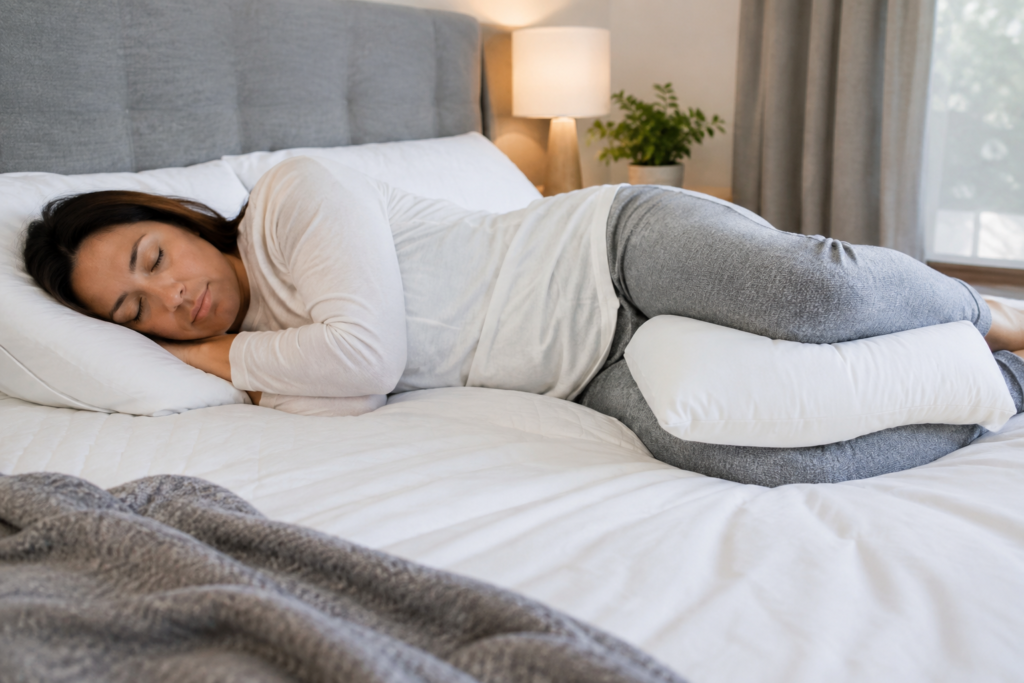
For many people with lower back discomfort, side sleeping can be a comfortable option. The key is positioning your legs and hips correctly.
When sleeping on your side, keep your knees slightly bent rather than pulling them tightly toward your chest. Then place a pillow between your knees. This can help keep your hips, pelvis, and spine better aligned and reduce twisting through the lower back.
A full-length body pillow can also provide support if you find it difficult to keep your legs in a comfortable position.
Try to avoid allowing your top knee to fall far forward because this can rotate the pelvis and potentially place additional stress on the lower back.
If one side feels more comfortable than the other, you can start there. However, changing sides periodically may prevent excessive pressure from remaining on one side of your body for the entire night.
For people who naturally prefer side sleeping, this can be an excellent starting point when searching for the best sleeping position for lower back pain.
Sleeping on Your Back
Sleeping on your back is another position that may help support the lower back. Lying on your back distributes your body weight across the mattress and can make it easier to maintain a neutral spinal position.
One simple modification is placing a pillow underneath your knees. This can help relax the back muscles and support the natural curve of your lower back. Mayo Clinic also notes that a small rolled towel underneath the waist may provide additional support for some people.
Your head pillow matters as well. It should support your neck without pushing your head too far forward. Ideally, your head and neck should remain aligned with the rest of your spine.
If lying completely flat causes discomfort, experiment with the height and placement of the pillow underneath your knees. A small adjustment can sometimes make the position considerably more comfortable.
Is Sleeping on Your Stomach Bad for Lower Back Pain?
Stomach sleeping is often less favorable for people experiencing lower back pain because it can place additional stress on the spine and requires the head to remain turned to one side for breathing.
If you cannot comfortably sleep in another position, you do not necessarily have to force yourself to completely change your sleeping habits overnight. Instead, consider placing a thin pillow underneath your hips or lower abdomen. This may help reduce some of the strain associated with the position.
You can also experiment with using a thinner head pillow to avoid excessive elevation of your head and neck.
If stomach sleeping consistently causes increased pain, however, trying side or back sleeping may be worthwhile.
How to Use Pillows for Better Spinal Support
Pillows are more than a comfort accessory. When positioned correctly, they can help maintain alignment while you sleep.
For side sleepers, a pillow between the knees is one of the simplest adjustments to try. It helps prevent the upper leg from pulling the pelvis forward.
For back sleepers, placing a pillow underneath the knees may reduce excessive arching in the lower back.
Your head pillow should also be appropriate for your sleeping position. Side sleepers may need a thicker pillow to fill the space between the shoulder and head, while back sleepers often require less height.
The goal is not to use as many pillows as possible. The goal is to use enough support to keep your body comfortable and aligned.
Choosing the Right Mattress
Your sleeping position is only one part of nighttime comfort. Your mattress can also influence how your body feels in the morning.
A mattress that allows your hips to sink excessively may place the spine in an uncomfortable position. On the other hand, a surface that is extremely firm may create pressure points around the hips and shoulders.
There is no universally perfect mattress for everyone with lower back pain. Personal comfort, body weight, sleeping position, and individual preferences all matter.
If your mattress is old, sagging, or visibly uneven, it may be worth evaluating whether it is contributing to your discomfort.
How to Get Out of Bed Without Straining Your Back
Even after finding the best sleeping position for lower back pain, the way you get out of bed can affect how your back feels in the morning.
Instead of quickly sitting straight up from a lying position, turn onto your side first. Bend your knees slightly, move your legs toward the edge of the bed, and use your arms to help push your upper body into a seated position.
This approach can reduce sudden twisting or flexing of the lower back.
Once seated, take a moment before standing. If your back feels stiff in the morning, moving slowly can help you avoid an abrupt strain.
What If Your Back Pain Continues?
Changing your sleeping position can be helpful, but it should not be considered a complete treatment for persistent or severe lower back pain.
Back pain can have many potential causes, including muscle strain, joint problems, disc-related conditions, nerve irritation, and other issues. The appropriate approach depends on the underlying cause.
If your pain repeatedly interrupts sleep, continues to worsen, or affects your ability to perform normal activities, consider discussing your symptoms with a qualified healthcare professional.
A Naples Chiropractor may also evaluate spinal alignment, movement patterns, and other musculoskeletal factors when chiropractic care is appropriate for your situation.
Seek prompt medical attention for severe symptoms or concerning changes such as significant weakness, numbness, or loss of bladder or bowel control.
A Simple Nighttime Routine for Lower Back Comfort
If lower back pain is affecting your sleep, try making one change at a time rather than completely changing your routine.
Start by choosing either side sleeping with a pillow between your knees or back sleeping with a pillow under your knees. Pay attention to how your back feels when you wake up.
Next, check whether your head pillow keeps your neck comfortable. If necessary, adjust its height.
Finally, evaluate your mattress and sleeping environment. A comfortable temperature, adequate support, and a consistent bedtime routine can all contribute to better-quality sleep.
Remember that comfort is an important guide. If a particular position consistently increases your pain, it may not be the right choice for you.
Finding the Best Sleeping Position for Lower Back Pain
There is no universal sleeping posture that guarantees a pain-free morning. However, side sleeping with a pillow between the knees and back sleeping with a pillow under the knees are commonly recommended approaches for supporting spinal alignment.
The best sleeping position for lower back pain is the one that allows you to sleep comfortably while keeping your spine supported and avoiding positions that increase your symptoms.
Small changes can make a meaningful difference. Adjusting your knees, adding a supportive pillow, changing your sleeping position, or evaluating your mattress may help you wake up feeling more comfortable.
If nighttime back pain persists despite these adjustments, professional evaluation can help determine whether an underlying condition needs attention.
Frequently Asked Questions
What is the best sleeping position for lower back pain?
Side sleeping with the knees slightly bent and a pillow between the knees is commonly recommended. Back sleeping with a pillow underneath the knees is another supportive option. The best choice depends on your individual symptoms and comfort.
Is it better to sleep on your back or side with lower back pain?
Both can be helpful. Side sleeping with a pillow between the knees can support alignment, while back sleeping with a pillow under the knees may reduce strain on the lower back. Try both and determine which position feels more comfortable for you.
Should I put a pillow under my lower back?
Some people may benefit from additional lumbar support, but too much support can be uncomfortable. If you sleep on your back, a pillow under your knees is generally a simpler adjustment to try first. Mayo Clinic also notes that a small rolled towel under the waist may provide additional support for some people.
Is sleeping on your stomach bad for your back?
Stomach sleeping can place additional strain on the lower back and neck. If you cannot sleep comfortably in another position, placing a pillow under your hips and lower abdomen may help reduce some strain.
Why does my lower back hurt more in the morning?
Morning back pain can have several possible causes. Sleeping in an unsupported position, remaining in one posture for an extended period, mattress problems, muscle tension, or an underlying condition may contribute. Persistent or worsening pain should be evaluated by a qualified healthcare professional.
Can changing my sleeping position cure lower back pain?
Changing your sleeping position may reduce nighttime discomfort or morning stiffness, but it does not necessarily address the underlying cause of back pain. Persistent symptoms may require professional evaluation and an individualized treatment plan.
When should I see a professional about lower back pain?
Consider professional evaluation if pain is severe, persistent, worsening, repeatedly disrupting sleep, or interfering with everyday activities. Seek urgent medical attention for serious symptoms such as significant weakness, loss of bladder or bowel control, or other sudden neurological changes.