
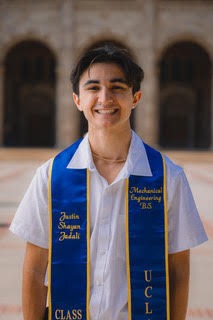
Building functional tissue in a lab requires more than biological intuition — it demands the kind of systematic, cross-disciplinary thinking that engineers are trained to apply. Justin Jadali, a mechanical engineering researcher pursuing his M.S. at Yale University, is doing exactly that. Working at the intersection of polymer science, cell biology, and additive manufacturing, Jadali is developing alginate-based microparticle systems aimed at improving how engineered tissues form functional blood vessel networks.
From Physics and Math to Polymer Scaffolds: An Unusual Path Into Research
Jadali’s academic trajectory is atypical by most measures. After earning a 36 on the ACT, he skipped his final two years of high school and enrolled at Irvine Valley College, where he completed three Associate of Science degrees — in Physics, Mathematics, and Natural Sciences. He transferred to UCLA, graduating with a B.S. in Mechanical Engineering as part of the Class of 2025.
At UCLA, Jadali augmented his engineering curriculum with a full year of biology and a full year of organic chemistry. That decision was deliberate. For researchers who want to operate across wet-lab and fabrication environments, understanding cellular mechanics and chemical behavior is not supplemental — it is foundational. The combination positioned him to move fluidly between engineering constraints and biological systems, a capability that now defines his work at Yale.
Alginate Microparticles and the Problem of Vascularization
One of the central challenges in tissue engineering is vascularization — the process by which engineered constructs develop the blood vessel networks necessary to sustain living tissue. Without adequate vascularization, cells in the interior of thick tissue constructs cannot receive oxygen and nutrients, limiting the clinical viability of bioengineered materials.
At Yale, Jadali works with alginate-based microparticles as a tool for addressing this challenge. Alginate, a polysaccharide derived from brown seaweed, crosslinks readily with divalent cations and is broadly used in biomedical applications due to its biocompatibility and tunable mechanical properties. Jadali fabricates these microparticles and systematically examines how crosslinking chemistry affects their behavior — specifically comparing calcium crosslinking against zinc crosslinking in current experimental batches.
The distinction matters. Calcium and zinc crosslinking produce gels with different mechanical stiffness profiles, degradation kinetics, and ion-release patterns. Each variable has downstream consequences for how encapsulated or adjacent cells behave. By characterizing these differences rigorously, Jadali’s work creates a cleaner empirical foundation for designing particle systems that influence vessel self-assembly in predictable ways.
Cell Culture, Microscopy, and Quantifying Microvessel Formation
The experimental work extends well beyond particle fabrication. Jadali runs cell culture experiments using endothelial cells, pericytes, and fibroblasts — the three primary cell types involved in microvessel formation and stabilization. Endothelial cells form the inner lining of blood vessels; pericytes wrap around small vessels and regulate blood flow; fibroblasts provide structural support within connective tissue. Working with all three in concert reflects the complexity of replicating vascular architecture rather than isolating any single element.
To assess outcomes, Jadali uses microscopy workflows to examine microvessel formation and structure. His research aims to quantify how microparticle properties and controlled release cues change how vessels self-assemble within 3D gels and bioprinted skin constructs. That word — quantify — is doing important work here. Descriptive observations of vessel-like structures are common in the field; systematic, reproducible quantification of how specific material parameters drive those structures is considerably harder and considerably more useful.
Reproducibility is a priority Jadali returns to consistently. He maintains detailed experimental protocols, tracks batch variables across fabrication runs, and emphasizes clean SOP design as a precondition for meaningful data — a discipline that reflects both his engineering training and the realities of working in a wet-lab environment where uncontrolled variables erode confidence in results.
Additive Manufacturing as a Tool for Medical Engineering
Jadali’s engagement with 3D printing predates his graduate research. He has been involved in additive manufacturing for years, using it for rapid prototyping and iterative design in medical engineering contexts. He volunteered at his middle school teaching students to operate 3D printers, and he currently serves as a teaching assistant for the Yale Mechanical Engineering Capstone.
In the context of tissue engineering, additive manufacturing intersects directly with his research. Bioprinting — printing cell-laden bioinks into defined 3D geometries — represents one of the primary application spaces for the microparticle and vascularization systems he is developing. The ability to move between designing a fabrication workflow and understanding the biological constraints it must satisfy is not a common skill set. Jadali has structured his education and research to develop both sides of that capability.
Entrepreneurial Execution in a Technical Career
Before graduate school, Jadali founded and operated an e-commerce business selling exotic insects and affiliated supplies. The company grew to approximately 10 employees at its peak and was later sold at a six-figure valuation.
The experience is worth noting not as a biographical footnote but as evidence of a particular kind of operational capability — building systems, managing people, and executing under resource constraints. Those are skills that do not transfer automatically from an academic environment, and they distinguish Jadali’s profile from researchers whose experience is confined to lab settings.
About Justin Jadali
Justin Jadali is a mechanical engineer and biomedical engineering researcher specializing in biomaterials, vascularization, and tissue engineering. He holds three Associate of Science degrees from Irvine Valley College and a B.S. in Mechanical Engineering from UCLA (Class of 2025). He is currently completing his M.S. in Mechanical Engineering and Materials Science at Yale University, where his research focuses on alginate microparticle fabrication, crosslinking systems, and microvessel self-assembly in 3D gels and bioprinted constructs. He is also a Teaching Assistant for the Yale Mechanical Engineering Capstone. Jadali grew up in Newport Beach, California, and speaks English and Farsi.